SNU MBA Applied Business Project
An MBA graduation project that combines market reactions with online stakeholder data to evaluate cybersecurity crisis-response options.
Decision problem
After a major Korean e-commerce platform disclosed a personal-data breach, I looked at which response package could limit further damage to customer trust and long-term enterprise value.
The question was not whether the breach was inherently wrong. It was how the response set off perceptions of fairness, responsibility, and betrayal, and which strategy could ease them.
Crisis chronology
I laid out the initial disclosure, the follow-up information, customer protection, government findings, and legal proceedings on a single timeline. The unit of analysis was a sequence of disclosures and outside reinterpretations, not any one announcement.
Market reaction
A market-model event study compared abnormal and cumulative abnormal returns around the major disclosures. I kept the narrow event-window shocks separate from the later recovery paths, and did not treat any single announcement as proof of a long-term causal effect.
-4.44%
Initial disclosure CAR[-1,+1]
+6.82%
Customer compensation announcement CAR[-1,+1]
-4.73%
Government findings announcement CAR[-1,+1]
The signs held across four benchmark specifications. These narrow-window results show the market repricing around disclosures, not a standalone long-term causal effect.
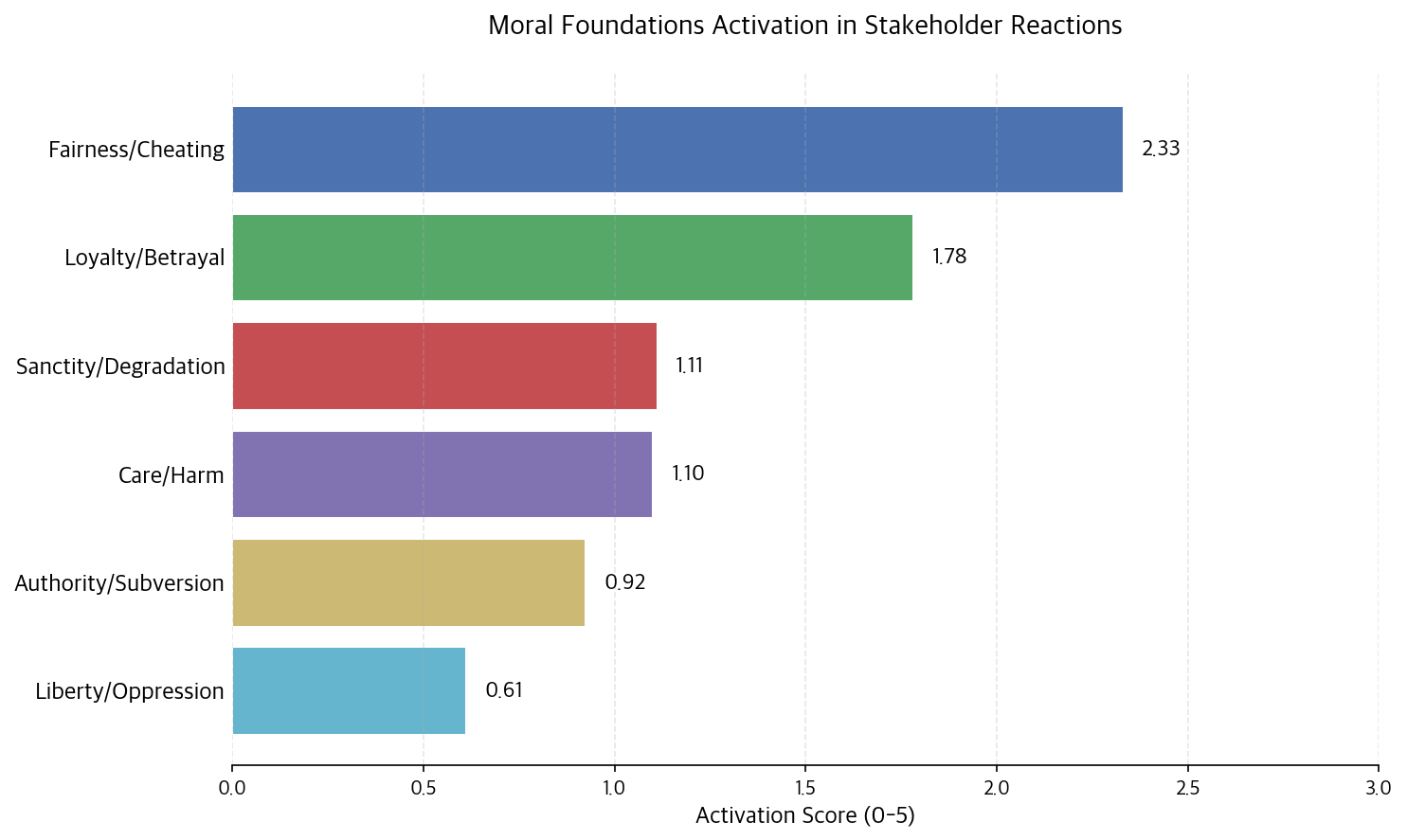
Chart summary and data
Negative reactions dominate the coded distribution. The labels are model outputs and describe this collected sample, not the public as a whole.
| Label | Count | Share |
|---|---|---|
| Negative | 6,009 | 72.70% |
| Neutral | 1,044 | 12.63% |
| Mixed | 717 | 8.68% |
| Positive | 495 | 5.99% |
72.7% negative
The share was only the first clue. The reaction centered on fairness, responsibility, and governance criticism far more than on generic dissatisfaction.
Stakeholder reactions
I coded 8,265 analyzable online reactions for sentiment, Moral Foundations, and topic intensity. Since the platforms differed in both sample and tone, I compared overall averages alongside the high-intensity reactions on each one.
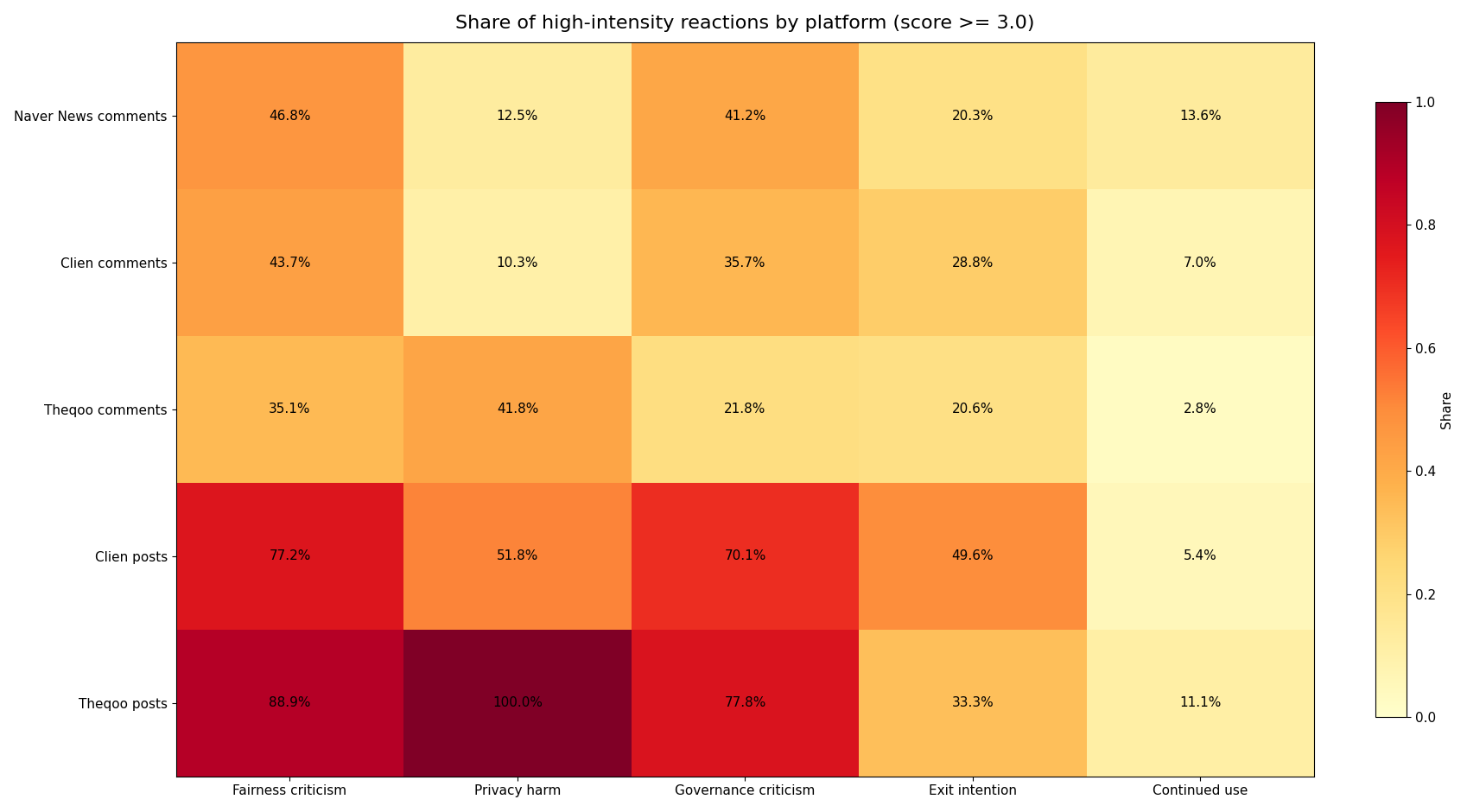
Chart summary and data
Naver News comments and Clien comments both show high fairness and governance criticism. Clien comments carry a higher exit-intention share than Naver News comments. The post samples are much smaller than the comment samples, and the Theqoo post sample is just nine items, so their higher percentages are not a platform ranking.
| Platform | n | Fairness | Privacy harm | Governance | Exit | Continued use |
|---|---|---|---|---|---|---|
| Naver News comments | 2,943 | 46.76% | 12.54% | 41.25% | 20.29% | 13.59% |
| Clien comments | 3,446 | 43.73% | 10.30% | 35.72% | 28.76% | 6.96% |
| Theqoo comments | 1,516 | 35.09% | 41.75% | 21.77% | 20.58% | 2.77% |
| Clien posts | 351 | 77.21% | 51.85% | 70.09% | 49.57% | 5.41% |
| Theqoo posts | 9 | 88.89% | 100.00% | 77.78% | 33.33% | 11.11% |
Comparative cases
I compared disclosure speed, customer protection, external validation, and regulatory outcomes across Korean and global cybersecurity crises. Across the cases, fast notice and compensation were not enough on their own without credible validation and governance action.
Strategic alternatives
I compared three response packages: limited disclosure with minimal protection; rapid disclosure with customer protection and staged updates; and that same package plus independent validation and stronger governance.
The criteria covered perceptions of fairness and accountability, regulatory risk, market uncertainty, how consistent later disclosures were, cost, and how feasible each package was to execute.
Recommendation
I recommended treating rapid disclosure and customer protection as the baseline, reinforced by independent validation, board oversight, a redesign of controls, and explicit standards for later updates.
The recommendation does not promise to erase the short-term backlash. It gives outside stakeholders a reason to trust future disclosures and control improvements.
Relationship to Probato
Probato had already begun in 2024 as an independent research and product direction. This is a later MBA graduation project that applies the same kind of qualitative stakeholder analysis to a separate decision problem. The two share a skill set, but they are not one continuous project.
Limitations
The project never ran the planned interviews or focus groups, so it could not observe internal decisions or customer experience firsthand. The online reactions were concentrated on a few platforms and do not represent public opinion as a whole.
The event study describes market movement around the disclosures but does not establish a standalone causal effect. And the LLM coding is model output, not human ground truth.